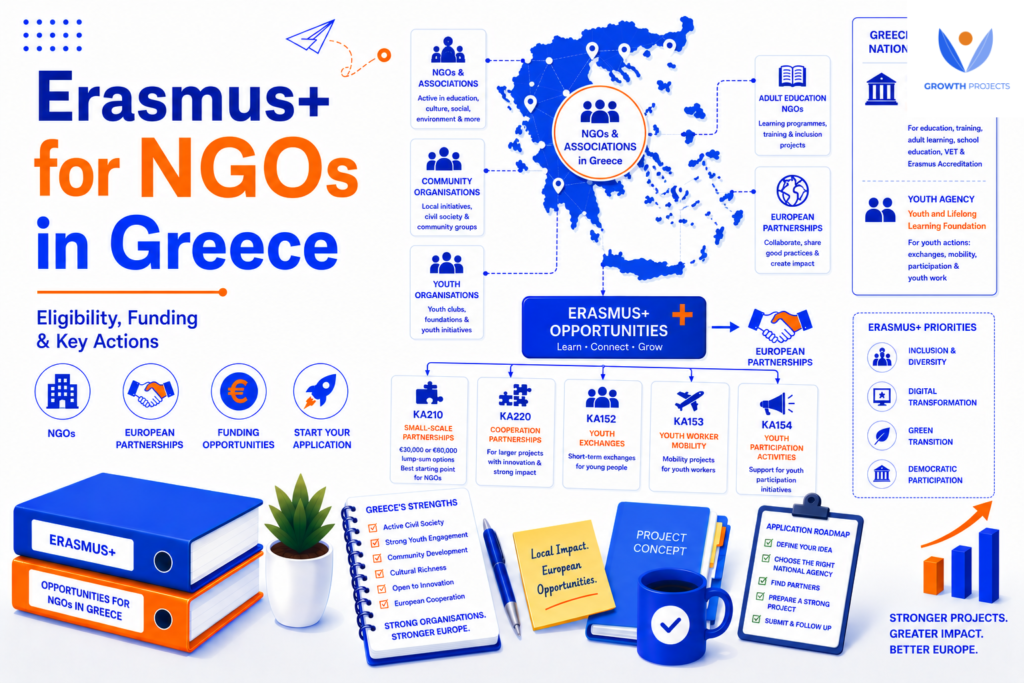
Italy has one of the largest and most active civil society sectors in Europe — tens of thousands of associations, NGOs, social cooperatives and non-profit organisations working across education, youth, culture, social services, environmental protection and community development. Erasmus+ is one of the most accessible European funding programmes for Italian NGOs, yet many organisations either do not know they are eligible or find the programme too complex to navigate on their own.
This guide covers everything an Italian NGO needs to know about Erasmus+ in 2026 — which actions are open, how much funding is available, what the requirements are, and how to approach an application successfully.
📋 Key Takeaways
- Italian NGOs — associations, social cooperatives, foundations and non-profit bodies — are eligible for multiple Erasmus+ actions
- KA210 is the recommended starting point — no prior EU project experience required, lump sum of €30,000 or €60,000
- Italy’s National Agency for Erasmus+ is INDIRE (Istituto Nazionale di Documentazione, Innovazione e Ricerca Educativa)
- The Agenzia Nazionale per i Giovani (ANG) manages youth-specific actions KA152, KA153 and KA154 for Italy
- 2026 deadlines: 12 February (KA152/KA153), 5 March (KA210/KA220)
- Italy is one of the most active Erasmus+ countries in Europe — competition is high but so is the budget allocation
Is my Italian NGO eligible for Erasmus+?
The Erasmus+ Programme Guide defines eligible organisations broadly: any public or private body legally established in a programme country can participate in most actions. This explicitly includes non-profit organisations, associations (associazioni), social cooperatives (cooperative sociali), foundations (fondazioni) and other non-profit legal forms recognised under Italian law.
The key eligibility conditions by action type are:
- Legal registration: Your organisation must be legally established in Italy (or another programme country) — registered with the appropriate Italian authority (Registro delle Persone Giuridiche, Registro delle APS/ODV under the Codice del Terzo Settore, or equivalent)
- OID number: Before applying for any Erasmus+ action, your organisation must be registered on the EU Organisation Registration System and hold a valid Organisation ID (OID). Registration is free and takes approximately 10 working days
- Years established: For KA220 Cooperation Partnerships, the coordinator must have been legally established for at least 2 years before the application deadline. For KA210 Small-Scale Partnerships and most youth actions, there is no minimum age requirement
- Sector relevance: Italian NGOs working in education, youth, non-formal learning, adult education, social inclusion, culture, environment and civic participation are all well-positioned across the available actions
Important note on Terzo Settore reform
Following the Italian Codice del Terzo Settore reform, organisations registered as APS (Associazioni di Promozione Sociale), ODV (Organizzazioni di Volontariato) or other Terzo Settore entities are fully eligible for Erasmus+. If your organisation is in the transition process of registering with the RUNTS (Registro Unico Nazionale del Terzo Settore), it can still apply using its current legal status — RUNTS registration is not a requirement for Erasmus+ eligibility.
The Italian National Agencies: INDIRE and ANG
Unlike most countries, Italy has two separate National Agencies for Erasmus+ — one for education and training actions, and one for youth actions.
INDIRE — for education, training and adult learning
INDIRE (Istituto Nazionale di Documentazione, Innovazione e Ricerca Educativa) manages all Erasmus+ actions in the fields of school education, vocational education and training, adult education and higher education in Italy. This includes KA1 mobility for schools, VET and adult education, KA210 and KA220 in these fields, and the Erasmus Accreditation.
INDIRE
Website: www.indire.it/erasmusplus
Address: Via Cesare Lombroso 6/15, 50134 Firenze
ANG — for youth actions
The Agenzia Nazionale per i Giovani (ANG) manages all Erasmus+ youth actions in Italy — including Youth Exchanges (KA152), Youth Worker Mobility (KA153), Youth Participation Activities (KA154), and KA210/KA220 in the youth field.
ANG — Agenzia Nazionale per i Giovani
Website: www.agenziagiovani.it
Address: Via Sabotino 4, 00195 Roma
The choice of which National Agency handles your application depends on your field — if your NGO works in youth non-formal education, ANG is your contact. If your NGO works in adult learning or formal education, INDIRE is your contact. If your NGO works across both fields, you can apply to both agencies in different applications in the same call.
Which Erasmus+ actions are available to Italian NGOs?
KA210 — Small-Scale Partnerships (recommended starting point)
KA210 is the most accessible Erasmus+ action for Italian NGOs applying for the first time. It is explicitly designed for smaller and less experienced organisations — the requirements are simplified, the grant model removes the need to track individual expenses, and no prior EU project experience is required.
| Grant amount | €30,000 or €60,000 — lump sum, selected at application stage |
| Minimum partners | 2 organisations from 2 different programme countries |
| Project duration | 6 to 24 months |
| Experience required | None — designed for first-time applicants |
| 2026 deadline | 5 March 2026 (primary) — check INDIRE or ANG for second round |
| Fields | School education, VET, adult education, youth, sport |
| Max applications | 5 applications per deadline (as coordinator or partner) |
| Grant model | Lump sum — no receipts required, payment based on activity delivery |
KA210 is ideal for Italian NGOs that want to develop a transnational project with one European partner — sharing practices, running joint training workshops, developing educational tools or producing community resources. The lump sum model is particularly attractive for smaller Italian organisations that lack the financial management infrastructure to track and report on individual expense receipts.
One strategic note for Italian NGOs: Italy is one of the most competitive Erasmus+ markets in Europe. The number of applications is very high and the evaluation is rigorous. A good KA210 application is not just eligible — it needs to be genuinely well-designed, clearly connected to the 2026 priorities, and specific about what the project will produce and for whom. Generic applications score poorly regardless of how experienced the applicant organisation is.
KA220 — Cooperation Partnerships
KA220 is the full-scale cooperation action offering larger lump sum grants for organisations with project management capacity and a clear innovation or knowledge-sharing objective. Italian NGOs with prior EU project experience that want to develop ambitious transnational projects with multiple partners should consider KA220.
| Grant amount | €120,000 / €250,000 / €400,000 — three lump sum tiers |
| Minimum partners | 3 organisations from 3 different programme countries |
| Project duration | 12 to 36 months |
| Experience required | Coordinator must be established at least 2 years before deadline |
| 2026 deadline | 5 March 2026 |
| Max applications | 10 applications per deadline (as coordinator or partner) |
KA152 — Youth Exchanges (managed by ANG)
For Italian youth organisations and NGOs working with young people aged 13–30, Youth Exchanges offer a straightforward, impactful way to connect young Italians with their European peers. Groups of young people from two or more countries meet for a structured non-formal learning programme — typically 6–21 days — on a shared theme.
KA152 at a glance (Italy — managed by ANG)
Grant model: unit costs (travel + individual support) · Participants: 10–60 young people from 2+ countries · Age: 13–30 · 2026 deadlines: 12 February (Round 1) and 1 October (Round 2) · Youthpass mandatory for all participants
Youth Exchanges are particularly well-suited to Italian youth organisations and local associations working on topics like active citizenship, environmental education, media literacy, social inclusion and intercultural dialogue. The 2026 Programme Guide prioritises projects that genuinely include young people with fewer opportunities — Italian NGOs working in disadvantaged communities, with immigrant young people or with those facing social barriers are well-positioned to score strongly on this criterion.
KA153 — Youth Worker Mobility (managed by ANG)
KA153 funds professional development for Italian youth workers, educators and trainers through learning visits, seminars, job shadowing and training courses abroad. If your organisation employs or works with youth facilitators, non-formal educators or community workers, this action directly supports their professional development.
KA153 at a glance (Italy — managed by ANG)
Grant model: unit costs · Any number of participants · 2026 deadlines: 12 February (Round 1) and 1 October (Round 2) · Duration: 3–24 months
KA154 — Youth Participation Activities (managed by ANG)
KA154 funds civic engagement and democratic participation activities for young people. Projects can be national or transnational. For Italian NGOs working on local democracy, civic education or European citizenship, this is the most flexible youth action — it covers a wide range of formats and can be implemented at a local level without requiring a large international consortium.
KA122-ADU — Short-term Mobility Projects for Adult Education (managed by INDIRE)
Italian NGOs active in adult learning — literacy programmes, skills training, digital inclusion for older adults, community education — are eligible for KA122-ADU. This funds staff professional development through learning visits and training courses abroad. It is the entry-level adult education mobility action with no experience required and a cap of 30 participants per project.
KA122-ADU at a glance (Italy — managed by INDIRE)
Grant model: unit costs · Maximum 30 participants · 2026 deadlines: 19 February (Round 1) and 1 October (Round 2) · Duration: 6–18 months
How much funding can an Italian NGO receive?
| Action | Grant Model | Typical Range | NA |
|---|---|---|---|
| KA210 | Lump sum | €30,000 or €60,000 | INDIRE or ANG |
| KA220 | Lump sum | €120,000 – €400,000 | INDIRE or ANG |
| KA152 Youth Exchange | Unit costs | €8,000–€25,000 (typical 20-participant exchange) | ANG |
| KA153 Youth Worker Mobility | Unit costs | €5,000–€15,000 (typical 5–10 staff) | ANG |
| KA122-ADU | Unit costs | €10,000–€30,000 (typical 10–20 participants) | INDIRE |
2026 Erasmus+ deadlines for Italian NGOs
| Action | Round 1 | Round 2 | National Agency |
|---|---|---|---|
| KA210 (Education/Adult) | 5 March 2026 | Check INDIRE | INDIRE |
| KA210 (Youth) | 5 March 2026 | Check ANG | ANG |
| KA220 | 5 March 2026 | Check INDIRE/ANG | INDIRE or ANG |
| KA152 Youth Exchanges | 12 February 2026 | 1 October 2026 | ANG |
| KA153 Youth Worker Mobility | 12 February 2026 | 1 October 2026 | ANG |
| KA154 Youth Participation | 12 February 2026 | 1 October 2026 | ANG |
| KA122-ADU Adult Education | 19 February 2026 | 1 October 2026 | INDIRE |
All deadlines at 12:00 Brussels time. Always verify with INDIRE (indire.it/erasmusplus) or ANG (agenziagiovani.it) before submitting — both agencies publish national guidance after the Programme Guide is released and may set slightly different national conditions.
The 2026 priorities: what Italian NGOs should address
Every Erasmus+ application is evaluated against four horizontal priorities. Italian NGOs are generally well-positioned across all four — the key is to integrate them genuinely into your project design rather than simply listing them.
- Inclusion and diversity — reaching people with fewer opportunities: people with disabilities, immigrants and refugees, people from socioeconomically disadvantaged backgrounds, and people from remote or rural areas. Italy’s diverse civil society sector is particularly strong in this area
- Digital transformation — developing digital skills, using digital tools in non-formal education, addressing digital exclusion among older adults and disadvantaged communities
- Environment and climate change — environmental education, sustainable practices in project design, green travel for trips under 500km
- Democratic participation and active citizenship — civic engagement, media literacy, critical thinking and European values — particularly relevant for youth and adult education NGOs
One practical note: Italian evaluators and INDIRE/ANG assessors are well-versed in identifying applications that mention priorities without integrating them. A project that claims to address inclusion but has no specific activities targeting disadvantaged participants will score poorly on relevance. Make the connection between your priorities and your project activities explicit and specific.
How to apply: the step-by-step process
Step 1 — Register your OID. Go to the EU Academy portal, create an account and register your organisation to obtain an OID. Required for all Erasmus+ applications. Free and takes up to 10 working days — do not leave this for the last week before the deadline.
Step 2 — Decide which National Agency and which action. If your NGO works in youth non-formal education — apply to ANG. If it works in adult learning, education or training — apply to INDIRE. If it spans both fields, you can apply to both in different applications. Choose your action based on your project type: KA210 for first-time partnership projects, KA152/KA153 for youth mobility, KA122-ADU for adult education staff development.
Step 3 — Develop your project concept. A clear concept note before you start the application form will save significant time. Define: the problem your project addresses, the target group, the activities, the expected outputs and outcomes, and how the project connects to the 2026 priorities. For KA210, the concept should be realistic and proportionate to the €30,000 or €60,000 lump sum you intend to select.
Step 4 — Find your partners. Use EPALE (for adult education), the ANG partner search tool, or direct outreach through your existing European network. For KA210 you only need one partner from one other country — this is the most manageable first partnership. For KA220 you need at least two partners from two other countries, with a genuine strategic rationale for why each partner is in the consortium.
Step 5 — Write and submit your application. Applications are submitted online through the Erasmus+ application system. INDIRE and ANG both publish national guidance documents (in Italian) for each action — read these alongside the Programme Guide before writing. The form asks you to describe your organisation, your project concept, your partnership and your expected impact against the official evaluation criteria.
Step 6 — Monitor and follow up. INDIRE and ANG typically publish results 3–4 months after the deadline. If your application is unsuccessful, you will receive a Quality Assessment report explaining your scores per criterion — this is valuable feedback for improving a future application.
Is Your Italian NGO Ready to Apply for Erasmus+?
GrowthProjects.eu provides expert support for Italian NGOs applying for KA210, KA220, KA152 and KA153 — from eligibility check and project concept through to full proposal development. Contact us for a free initial consultation.
Free · No obligation · English-language support
Common mistakes Italian NGOs make when applying
Not distinguishing between INDIRE and ANG. Submitting a youth project to INDIRE or an adult education project to ANG is a basic error that means your application is processed by the wrong agency — and may be declared ineligible. Always verify which agency handles your field before submitting.
Underestimating the competition. Italy is one of the most active Erasmus+ countries in Europe. The number of KA210 and KA220 applications submitted to INDIRE and ANG is very high. A weak or generic application that might receive funding in a smaller national market will not compete effectively in Italy. Every section of the application must be specific, concrete and well-evidenced.
Selecting the wrong KA210 lump sum tier. Choosing €60,000 with an activity plan that only justifies €30,000 — or selecting €30,000 for an ambitious project that genuinely needs more resources — both lead to weak scores. The tier selection must be proportionate to the realistic cost of delivering the activities described.
Building a consortium based on existing friendships. Evaluators in Italy — as across all Erasmus+ markets — are experienced at identifying partnerships where the rationale is personal connection rather than strategic complementarity. Each partner in your consortium needs to bring something distinct: different expertise, a different target group, a different geographic context or a complementary methodology.
Neglecting the dissemination and exploitation plan. Italian evaluators pay particular attention to how projects plan to share and use their results beyond the project team. A KA220 application with a weak or generic dissemination plan will lose significant points on the Impact criterion. Be specific about where you will publish your results, who your secondary audience is, and how the outputs will continue to be used after the project ends.
Frequently asked questions
Can an Italian ODV or APS apply for Erasmus+?
Yes. Organisations registered as ODV (Organizzazioni di Volontariato) or APS (Associazioni di Promozione Sociale) under the Codice del Terzo Settore are fully eligible for all relevant Erasmus+ actions. Your OID registration should reflect your current legal form and registration number.
Does our Italian NGO need to have prior EU project experience?
For KA210 and all KA1 mobility actions — no. These actions are explicitly accessible to first-time applicants. For KA220, the coordinator must be established for at least 2 years, but prior EU project experience is not a stated eligibility requirement — though it significantly strengthens your application in practice. Italian evaluators are experienced and applications from organisations with no track record must compensate with an exceptionally strong project design and clear organisational capacity.
Can the same Italian NGO apply to both INDIRE and ANG in the same call?
Yes — if your organisation works across both education/adult learning and youth fields, you can submit separate applications to INDIRE and ANG in the same call. Each application is evaluated independently by the respective agency. The OID is the same regardless of which agency you apply to.
What happens if our KA210 application is rejected?
You will receive a Quality Assessment report from INDIRE or ANG explaining your evaluation scores per criterion. This feedback is extremely valuable — read it carefully and use it to redesign your project concept and strengthen the weakest sections before reapplying in the next call. Many successful Italian Erasmus+ projects were rejected once or twice before being funded.
Can an Italian NGO be a partner in a project coordinated by an organisation in another country?
Yes — and this is often a good starting point for Italian NGOs applying to Erasmus+ for the first time. Participating as a partner in a project coordinated by an experienced organisation in another country allows your NGO to gain programme experience, build its European network and understand the application and reporting process before coordinating its own project.
Ready to explore Erasmus+ for your Italian NGO?
GrowthProjects.eu specialises in supporting NGOs and non-profit organisations across Southern Europe and the Balkans — from eligibility checks and project concept development through to full proposal writing for KA210, KA220 and youth mobility actions. Our first consultation is always free.
All programme information is based on the official Erasmus+ Programme Guide 2026 (Version 1, published 12 November 2025). Deadlines and conditions are subject to confirmation by INDIRE and ANG — always verify current national information before submitting. GrowthProjects.eu is an independent consultancy and is not affiliated with INDIRE, ANG, the European Commission or EACEA.