The Western Balkans has one of the most active and connected youth sectors in the Erasmus+ programme. Youth organisations in Serbia, North Macedonia, Bosnia and Herzegovina, Albania, Kosovo and Greece have been participating in European youth exchanges, youth worker training and cooperation projects for years — and the 2026 call continues to offer significant, accessible funding specifically designed for youth organisations of all sizes and experience levels.
This guide covers the complete Erasmus+ landscape for youth organisations across the Balkans in 2026 — which actions are available, what the eligibility requirements are, how the funding works, which National Agency manages each country, and how to build a competitive application as a Balkan youth organisation.
📋 Key Takeaways
- Youth organisations in Serbia, North Macedonia and Greece are fully eligible for all Erasmus+ youth actions — on equal terms with EU Member States
- KA152 Youth Exchanges have two deadlines per year — 12 February and 1 October — making them the most accessible entry point
- Even informal groups of young people (minimum 4 members, one adult) can apply for KA152 without a registered organisation
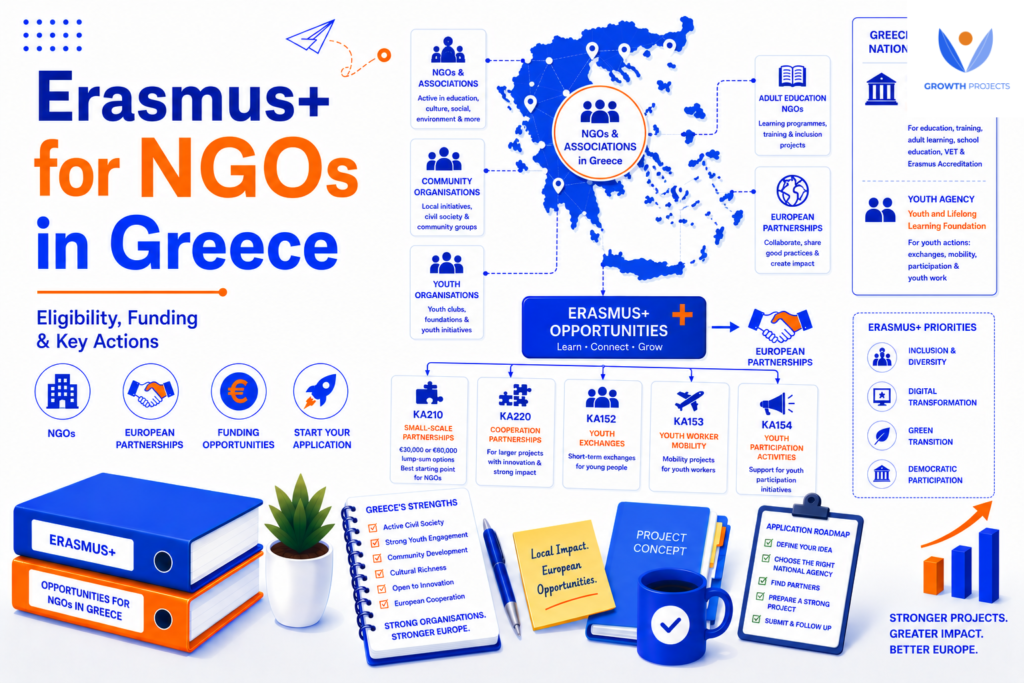
- KA210 Small-Scale Partnerships offers €30,000 or €60,000 lump sum for cooperation projects — no experience required
- Inclusion of young people with fewer opportunities is the top-scoring priority for Balkan youth organisations in 2026
- Youthpass must be issued to all participants in KA152, KA153 and KA154 activities
Which Balkan countries are fully in Erasmus+?
Understanding the Erasmus+ status of each Balkan country is the first step before applying. The situation varies by country:
| Country | Status | Eligible as Coordinator? | National Agency |
|---|---|---|---|
| Greece | EU Member State | ✓ Yes | IKY (erasmus.iky.gr) |
| Serbia | Candidate country — associated | ✓ Yes | Tempus Foundation (erasmusplus.rs) |
| North Macedonia | Candidate country — associated | ✓ Yes | CDEI (erasmusplus.mk) |
| Bosnia and Herzegovina | Potential candidate — associated | ✓ Yes | Agency for Pre-Primary, Primary and Secondary Education |
| Albania | Candidate country — associated | ✓ Yes | IKSHTE — National Agency (ikshte.gov.al) |
| Kosovo* | Potential candidate — Region 2 | ⚠ Partner only (most actions) | Check EACEA for specific actions |
*This designation is without prejudice to positions on status and is in line with UNSCR 1244/1999 and the ICJ Opinion on the Kosovo declaration of independence. Kosovo organisations should check their specific eligibility for each action with the relevant national authority before applying.
The key point for most Balkan youth organisations is that Greece, Serbia, North Macedonia, Bosnia and Albania all have full programme country status — meaning their organisations can coordinate projects, not just participate as partners.
Which actions are available to Balkan youth organisations?
KA152 — Youth Exchanges (most accessible starting point)
Youth Exchanges are the most accessible and most widely used Erasmus+ action for Balkan youth organisations. Groups of young people from two or more programme countries meet for a structured non-formal learning programme — typically 5–21 days — on a shared theme. Two application rounds per year give organisations maximum flexibility.
| Who can apply | Any registered youth organisation OR an informal group of at least 4 young people (one aged 18+) |
| Age of participants | 13 to 30 years old |
| Number of participants | Minimum 10, maximum 60 young participants (not counting group leaders) |
| Minimum partners | 2 groups from 2 different programme countries |
| Activity duration | 5 to 21 days (excluding travel days) |
| Grant model | Unit costs — travel + individual support + organisational support |
| 2026 deadlines | 12 February 2026 (Round 1) · 1 October 2026 (Round 2) |
| Youthpass | Mandatory for all participants |
Youth Exchanges are particularly well-suited to Balkan youth organisations for several reasons. The two-round annual deadline structure means that even organisations that miss the February deadline have another opportunity in October. The informal group provision means that a group of young people in Belgrade, Skopje or Thessaloniki can apply without a formally registered organisation — the lowest barrier to entry of any Erasmus+ action. And the inclusion priority that runs through the 2026 Programme Guide is naturally well-aligned with the genuine social contexts that Balkan youth organisations work in.
Important 2026 rule — inclusion projects minimum
For Youth Exchanges involving only young people with fewer opportunities, the minimum number of participants is 10 (same as standard projects). The 2026 Programme Guide makes inclusion of young people with fewer opportunities a top funding priority — projects that genuinely reach disadvantaged young people are evaluated more favourably on the Relevance criterion.
KA153 — Youth Worker Mobility
KA153 funds professional development for Balkan youth workers, trainers, facilitators and non-formal educators through learning visits, seminars, job shadowing and training courses in other programme countries. This is one of the most practically valuable actions for building the capacity of Balkan youth organisations — and one of the most underused.
| Who can apply | Youth organisations, NGOs, youth centres, public bodies active in youth work |
| Eligible participants | Youth workers, trainers, educators and staff of youth organisations |
| Activity types | Study visits, job shadowing, training courses, seminars, peer learning |
| Project duration | 3 to 24 months |
| Grant model | Unit costs — travel + individual support + organisational support |
| 2026 deadlines | 12 February 2026 (Round 1) · 1 October 2026 (Round 2) |
KA153 is particularly valuable for Balkan youth organisations that want to develop their methodological capacity — learning facilitation techniques, non-formal education approaches, project management skills or specialised competences (digital youth work, inclusion methodologies, environmental education) from more experienced European partners. The learning that youth workers bring back from KA153 activities directly strengthens the quality of future projects.
KA154 — Youth Participation Activities
KA154 funds activities that encourage young people to participate actively in democratic and civic life. Projects can be national or transnational — one of the few Erasmus+ actions that can be implemented without an international partner. Formats are flexible: local civic initiatives, online engagement platforms, youth councils, policy dialogues, community action projects.
KA154: Unit costs · National or transnational · Democratic participation focus required · Youthpass mandatory · 2026 deadlines: 12 February (Round 1) and 1 October (Round 2)
For Balkan youth organisations, KA154 has particularly strong resonance in the 2026 call. The Programme Guide explicitly connects democratic participation to EU values, civic engagement and the accession process — all deeply relevant themes for organisations in Serbia, North Macedonia, Albania and Bosnia. Projects addressing media literacy, disinformation, EU citizenship awareness and youth involvement in local governance are strongly prioritised.
KA210 — Small-Scale Partnerships for Youth
For Balkan youth organisations that want to move beyond mobility activities and develop a longer-term transnational project, KA210 is the most accessible cooperation action. It is designed for first-time applicants, requires only one partner from another programme country and uses a simplified lump sum grant model.
KA210 Youth: €30,000 or €60,000 lump sum · Min. 2 organisations from 2 countries · No experience required · Duration 6–24 months · Deadline: 5 March 2026 · No receipts required
A KA210 youth project might involve two partner youth organisations developing a shared non-formal education curriculum, building a community toolkit for youth workers in both countries, running joint online training sessions or producing resources on a shared topic — democratic participation, environmental education, inclusion, digital skills. The lump sum model means you receive the full grant on delivery of activities.
KA220 — Cooperation Partnerships for Youth
For experienced Balkan youth organisations with prior EU project management experience and an ambitious multi-country innovation objective, KA220 offers lump sum grants of €120,000, €250,000 or €400,000 for 12–36 month cooperation projects with at least 3 partners from 3 programme countries.
KA220 Youth: €120k–€400k lump sum · Min. 3 partners from 3 countries · Coordinator established 2+ years · Deadline: 5 March 2026
National Agencies for youth in the Balkans
Each Balkan programme country has its own National Agency managing youth actions. Knowing which agency handles your country is essential before you apply:
| Country | Youth National Agency | Website |
|---|---|---|
| Greece | IKY — State Scholarships Foundation | erasmus.iky.gr |
| Serbia | Tempus Foundation | erasmusplus.rs |
| North Macedonia | CDEI | erasmusplus.mk |
| Albania | IKSHTE — National Agency | ikshte.gov.al |
| Bosnia and Herzegovina | Agency for Pre-Primary, Primary and Secondary Education | aposo.gov.ba |
Applications for KA152, KA153 and KA154 are submitted to the National Agency of the applicant organisation’s country — not the host country. If a Serbian youth organisation is coordinating a youth exchange hosted in Greece, the application goes to the Tempus Foundation in Serbia.
2026 deadlines for Balkan youth organisations
| Action | Round 1 Deadline | Round 2 Deadline |
|---|---|---|
| KA152 — Youth Exchanges | 12 February 2026 | 1 October 2026 |
| KA153 — Youth Worker Mobility | 12 February 2026 | 1 October 2026 |
| KA154 — Youth Participation | 12 February 2026 | 1 October 2026 |
| KA210 — Small-Scale Partnerships (Youth) | 5 March 2026 | Check your NA |
| KA220 — Cooperation Partnerships (Youth) | 5 March 2026 | Check your NA |
All deadlines at 12:00 Brussels time. Always verify with your National Agency — they may publish national adjustments after the Programme Guide is released. The October round is useful if you miss the February deadline or want to plan activities for later in the year.
The 2026 priorities: what evaluators look for from Balkan youth organisations
The 2026 Programme Guide frames youth priorities around the EU Youth Strategy 2019–2027 and its three core areas: Connect, Engage and Empower. For Balkan youth organisations, the strongest priority alignments are:
Inclusion of young people with fewer opportunities
This is consistently the highest-scoring priority for Balkan youth applications. The Balkans offer genuine and verifiable inclusion contexts — rural communities with limited access to non-formal education, Roma and minority youth communities, young people with disabilities, young people facing socioeconomic barriers, young people in post-conflict communities. Applications that authentically address these realities — not just mention them — score significantly higher on Relevance. The Erasmus Youth Quality Standards require that inclusion be designed into the project from the start, not added as an afterthought.
Democratic participation and civic engagement
The 2026 Programme Guide places the strongest emphasis in years on democratic participation as a content priority. For Balkan youth organisations this is a natural and powerful angle — EU accession, civic education, media literacy, youth involvement in local governance, combating disinformation and strengthening democratic institutions are all directly relevant to the Western Balkans context and strongly aligned with this priority.
Digital competences for youth
Digital youth work, digital skills development for young people, online non-formal learning methodologies and digital inclusion for disadvantaged youth are all strongly prioritised. The Programme Guide explicitly encourages “digital and blended approaches in youth activities” and notes that digital tools can lower the threshold for participation of young people with fewer opportunities.
Environmental sustainability
Environmental education and climate awareness are expected in all youth projects. Green travel (train or bus) is the expected default for trips under 500km — and within the Balkans, most cross-border travel falls in Band A or B where green travel rates apply and are higher than standard rates.
What a typical Balkan youth exchange budget looks like
Here is a realistic budget example for a 7-day youth exchange hosted in Belgrade, with 20 participants from Serbia (10) and Greece (10):
Example: KA152 Youth Exchange — Belgrade, Serbia
Greek group: 10 participants travelling from Athens to Belgrade
- Distance Athens–Belgrade: approximately 990 km → Band C
- Travel grant (green travel): €417 × 10 participants = €4,170
- Individual support (Serbia destination): €120/day × 7 days × 10 = €8,400
- Travel days (2 green): €120 × 2 × 10 = €2,400
- Organisational support: €350 × 10 = €3,500
- Greek group total: €18,470
Serbian group: 10 participants (host — no travel grant)
- Individual support: €120/day × 7 days × 10 = €8,400
- Organisational support: €350 × 10 = €3,500
- Serbian group total: €11,900
Total exchange budget: approximately €30,370 — a realistic, fully funded 7-day exchange for 20 young people.
Ready to Apply for Your First Erasmus+ Youth Project?
GrowthProjects.eu supports youth organisations across the Balkans and Southern Europe — from eligibility checks and project concept through to full proposal development for KA152, KA153 and KA210. Our first consultation is always free.
Free · No obligation · English-language support
Common mistakes Balkan youth organisations make when applying
Not applying as coordinator because they think they need an EU partner to lead. This is the most common misconception. Serbian, North Macedonian, Albanian and Bosnian youth organisations can and do coordinate KA152 and KA153 projects — submitting the application to their own National Agency and leading the project. Full programme country status means full coordinator rights.
Missing the OID registration deadline. The OID is required before submitting any application. It takes up to 10 working days to process. Many Balkan youth organisations discover this requirement in the week before the February deadline. Register as soon as you decide to apply.
Treating Youthpass as optional. Youthpass is mandatory for all participants in KA152, KA153 and KA154 projects — it is not an optional add-on. Projects that do not plan for Youthpass issuance are non-compliant. Include explicit Youthpass implementation in your project design and your learning outcomes framework.
Writing activity descriptions without learning outcomes. Every Erasmus+ youth activity must have structured learning outcomes — specific competences, skills or knowledge that participants will gain. Applications that describe activities without connecting them to learning outcomes score poorly on the Quality of Project Design criterion.
Using inclusion language without genuine inclusion design. Writing “we will include young people with fewer opportunities” in the application without designing specific measures — adapted activities, inclusion support budget, accessible venues, support persons — is easily identified by evaluators. Genuine inclusion must be built into the project from the first planning stage.
Frequently asked questions
Can an informal group of young people in the Balkans apply for KA152?
Yes — for KA152 Youth Exchanges, an informal group of at least 4 young people between the ages of 13 and 30 can apply directly, provided one member is at least 18 years old and takes on the group representative role. The group must be established in a programme country. This means a group of young people in Belgrade, Skopje or Thessaloniki with no formal organisation can apply to their National Agency for a youth exchange.
Can a Balkan youth organisation coordinate a project with a Western European partner?
Yes. There is no restriction on which combination of programme countries can form a consortium. A Serbian youth organisation can coordinate a KA152 project with a partner in France, Germany or Italy — the application goes to the Tempus Foundation in Serbia, the Serbian organisation leads the project, and the Western European partner participates as a sending or receiving group.
What is Youthpass and how does it work?
Youthpass is the EU’s recognition tool for non-formal and informal learning in youth work. It is a certificate that describes what a participant did in an Erasmus+ youth activity and what competences they developed, based on the Youthpass framework of eight key competences. Youthpass is mandatory for all participants in KA152, KA153 and KA154 activities — issuing it is a grant condition, not optional. The Youthpass platform is free to use at youthpass.eu.
How long does it take to receive results after the February deadline?
National Agencies typically notify applicants of results 3–4 months after the submission deadline. For a 12 February deadline, results are usually communicated in May or June 2026. For the October round, results typically come in January or February of the following year.
Can a Balkan youth organisation apply for KA210 and KA152 in the same call?
Yes. There is no rule preventing a youth organisation from applying for a KA1 youth action (KA152 or KA153) and a KA2 cooperation action (KA210) in the same call — both are managed by the same National Agency and evaluated independently.
Need support with your Erasmus+ youth project application?
GrowthProjects.eu provides expert proposal support for youth organisations across the Balkans and Southern Europe — including KA152, KA153, KA154 and KA210 applications, and partner matching for organisations looking for Balkan partners. Our first consultation is always free.
All programme information is based on the official Erasmus+ Programme Guide 2026 (Version 1, published 12 November 2025). Country eligibility status confirmed from the Programme Guide Part A. Always verify current national information with your National Agency before submitting. GrowthProjects.eu is an independent consultancy and is not affiliated with any National Agency, the European Commission or EACEA.