North Macedonia has one of the longest-standing relationships with the Erasmus+ programme among the Western Balkans countries. As one of the first Western Balkans states to achieve candidate country status, North Macedonian organisations have been participating in Erasmus+ for years — yet many NGOs, schools, youth organisations and VET providers in the country still do not fully understand the scope of what is available to them or how to build a competitive application.
This guide covers the complete Erasmus+ landscape for North Macedonian organisations in 2026 — which actions are open, what the eligibility requirements are, how the funding works, what the deadlines are, and how to approach your first or next application.
📋 Key Takeaways
- North Macedonia is a candidate country fully associated to the Erasmus+ programme — organisations participate on equal terms with EU Member States
- The National Agency for Erasmus+ in North Macedonia is the CDEI (Centre for Development of Educational Information)
- KA210 is the recommended starting point — no experience required, lump sum of €30,000 or €60,000
- NGOs, schools, VET providers, youth organisations, universities and public bodies are all eligible
- Individual support rate for North Macedonia as a destination: €120/day (Country Group 3)
- 2026 deadlines: 12 February (KA152/KA153), 19 February (KA1 education), 5 March (KA210/KA220)
North Macedonia’s status in Erasmus+
North Macedonia is listed in the official Erasmus+ 2026 Programme Guide as a candidate country associated to the programme — the same status as Serbia, Türkiye and other Western Balkans accession countries. This is full programme country status.
This means North Macedonian organisations participate in Erasmus+ on equal terms with organisations from EU Member States. A North Macedonian NGO can coordinate a KA210 project, lead a KA220 consortium, host a youth exchange, apply for the Erasmus Accreditation and send staff abroad for professional development — all on the same footing as organisations from Poland, Greece or the Netherlands.
This full participation status is something many North Macedonian organisations are not fully aware of. The programme is not restricted to partnership roles — North Macedonian organisations can and regularly do lead Erasmus+ projects of their own.
The National Agency: CDEI
The National Agency responsible for managing Erasmus+ in North Macedonia is the CDEI — Centre for Development of Educational Information (Центар за развој на образовни информации). The CDEI manages all NA-managed Erasmus+ actions in North Macedonia including KA1 mobility, KA210, KA220, youth actions and the Erasmus Accreditation.
CDEI — Centre for Development of Educational Information
Website: www.cdei.mk
Erasmus+ section: erasmusplus.mk
Address: ul. Salvador Aljende 10, 1000 Skopje
The CDEI publishes national call information, application guidance and national deadline confirmations in both Macedonian and English. Their Erasmus+ portal (erasmusplus.mk) is the primary reference for all current call information. Always check the CDEI website before submitting — they may publish national adjustments or clarifications after the Programme Guide is released by the European Commission.
Which organisations in North Macedonia are eligible?
Erasmus+ is open to a wide range of organisations legally established in North Macedonia. Eligible types include:
- NGOs and civil society organisations — здруженија на граѓани (citizens’ associations), фондации (foundations) and other non-profit bodies registered under the Law on Associations and Foundations, active in education, youth, culture, social inclusion or civic participation
- Schools — основни училишта (primary schools), средни училишта (secondary schools), гимназии (gymnasiums) and other general and vocational education providers
- VET providers — стручни училишта (vocational schools), технички училишта (technical schools) and other organisations providing initial or continuing vocational training
- Higher education institutions — universities and other accredited HEIs holding a valid Erasmus Charter for Higher Education (ECHE)
- Youth organisations and centres — youth associations, informal youth groups and youth centres active in non-formal education
- Adult education providers — organisations providing non-formal learning for adults, skills training and professional development
- Public bodies — local governments (општини), municipalities, national authorities and public institutions active in education or youth
All organisations must obtain a valid Organisation ID (OID) before submitting any Erasmus+ application. Registration is free on the EU Academy portal and takes up to 10 working days. Do not leave this to the last week before the deadline.
Which Erasmus+ actions are available?
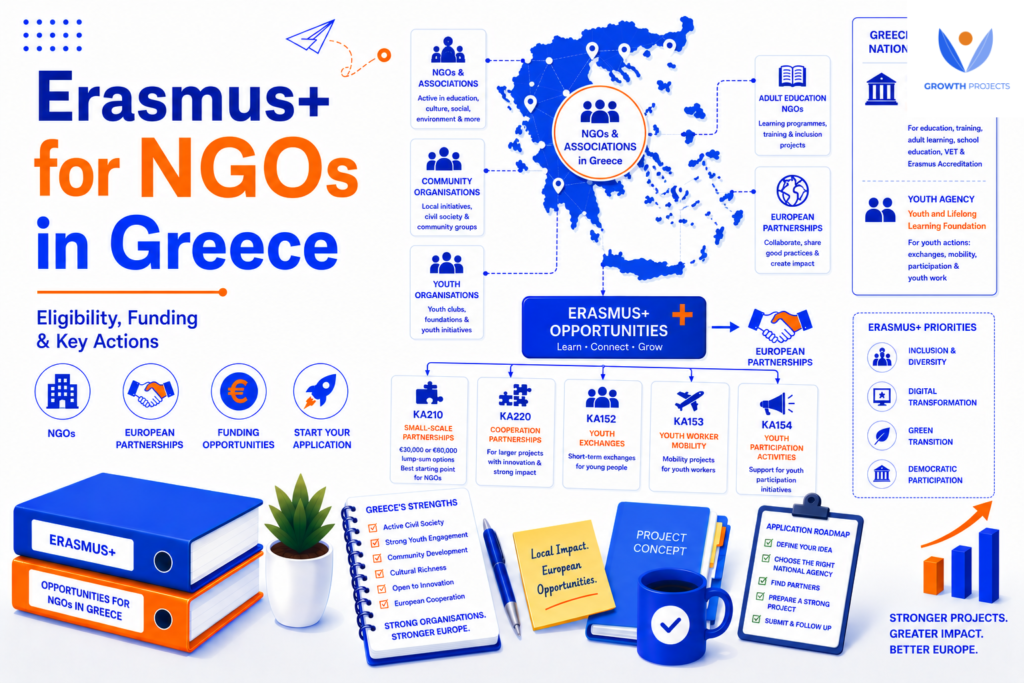
KA210 — Small-Scale Partnerships (recommended starting point)
KA210 is the most accessible and recommended first action for North Macedonian organisations. It is explicitly designed for smaller and first-time organisations — simplified requirements, lump sum grant with no receipts and no minimum experience needed.
| Grant amount | €30,000 or €60,000 — lump sum, no receipts required |
| Minimum partners | 2 organisations from 2 different programme countries |
| Project duration | 6 to 24 months |
| Experience required | None — designed for first-time applicants |
| 2026 deadline | 5 March 2026 — verify with CDEI for second round |
| Fields covered | School education, VET, adult education, youth, sport |
| Max applications | 5 per deadline as coordinator or partner |
KA210 is ideal for a North Macedonian NGO, school or youth organisation that wants to develop a transnational project with one European partner — sharing practices, developing educational tools, running joint workshops or building mutual capacity on a shared topic. The lump sum model is particularly practical for North Macedonian organisations that have limited infrastructure for tracking EU project expenses in detail.
Start with the €30,000 tier for your first application. It is proportionate to a focused 12–18 month project, more realistic for a first-time applicant to justify convincingly, and gives you a strong track record for a future €60,000 or KA220 application.
KA220 — Cooperation Partnerships
KA220 offers larger lump sum grants for North Macedonian organisations with prior project experience and a clear innovation or systemic impact objective. It requires a stronger consortium, a more complex application and a credible capacity to manage a multi-year transnational project.
| Grant amount | €120,000 / €250,000 / €400,000 — three lump sum tiers |
| Minimum partners | 3 organisations from 3 different programme countries |
| Project duration | 12 to 36 months |
| Experience required | Coordinator established at least 2 years before deadline |
| 2026 deadline | 5 March 2026 |
KA152 — Youth Exchanges
Youth Exchanges are one of the most impactful and accessible Erasmus+ actions for North Macedonian youth organisations. Groups of young people from two or more programme countries meet for structured non-formal learning — typically 6–21 days — on a shared topic. North Macedonian youth organisations regularly both host and send participants in Youth Exchanges.
KA152: Unit costs · 10–60 participants aged 13–30 · Minimum 2 groups from 2 programme countries · Youthpass mandatory · 2026 deadlines: 12 February (Round 1) and 1 October (Round 2)
KA153 — Youth Worker Mobility
Professional development for North Macedonian youth workers, trainers and non-formal educators through learning visits, seminars and job shadowing abroad. Two rounds per year. Relevant for any youth organisation or youth centre with staff working in non-formal education and community development.
KA153: Unit costs · Any number of participants · Duration 3–24 months · 2026 deadlines: 12 February (Round 1) and 1 October (Round 2)
KA154 — Youth Participation Activities
Funds civic engagement and democratic participation activities for young people. Can be national or transnational. Particularly relevant for North Macedonian youth organisations working on active citizenship, EU accession awareness and democratic values — topics with strong priority alignment in the 2026 call.
KA122 — Short-term Mobility for School, VET and Adult Education
North Macedonian schools, VET providers and adult education organisations can fund staff professional development through job shadowing, teaching assignments and training courses abroad. Entry-level KA1 action — no prior experience required, maximum 30 participants per project.
KA122-SCH/VET/ADU: Unit costs · Max 30 participants · Duration 6–18 months · 2026 deadlines: 19 February (Round 1) and 1 October (Round 2)
Erasmus Accreditation — School, VET and Adult Education
For North Macedonian schools, VET providers and adult education organisations committed to making European mobility a regular part of their institutional strategy, the Erasmus Accreditation provides simplified annual access to KA1 funding without reapplying each year.
Erasmus Accreditation: Annual simplified funding · Erasmus Plan required · No experience needed to apply · 2026 deadline: 29 September 2026
2026 Erasmus+ deadlines for North Macedonian organisations
| Action | Round 1 | Round 2 |
|---|---|---|
| KA152 Youth Exchanges | 12 February 2026 | 1 October 2026 |
| KA153 Youth Worker Mobility | 12 February 2026 | 1 October 2026 |
| KA154 Youth Participation | 12 February 2026 | 1 October 2026 |
| KA122-SCH / KA121-SCH | 19 February 2026 | 1 October 2026 |
| KA122-VET / KA121-VET | 19 February 2026 | 1 October 2026 |
| KA122-ADU / KA121-ADU | 19 February 2026 | 1 October 2026 |
| KA210 Small-Scale Partnerships | 5 March 2026 | Check CDEI |
| KA220 Cooperation Partnerships | 5 March 2026 | Check CDEI |
| Erasmus Accreditation | 29 September 2026 | — |
All deadlines at 12:00 Brussels time. Always verify with the CDEI at erasmusplus.mk before submitting — the CDEI may publish national adjustments after the Programme Guide is released.
How much funding can North Macedonian organisations receive?
| Action | Grant Model | Typical Range |
|---|---|---|
| KA210 | Lump sum | €30,000 or €60,000 |
| KA220 | Lump sum | €120,000 / €250,000 / €400,000 |
| KA122 School/VET/Adult | Unit costs | €8,000–€30,000 (typical 10–30 participants) |
| KA152 Youth Exchange | Unit costs | €8,000–€25,000 (typical 20-participant exchange) |
| KA153 Youth Worker Mobility | Unit costs | €5,000–€15,000 (typical 5–10 staff) |
The individual support rate for North Macedonia as a destination is €120/day — Country Group 3 in the Programme Guide, alongside Serbia, Bulgaria, Romania, Poland and other lower-cost destination countries. When North Macedonian participants travel to Western European destinations the higher destination rates apply — €160/day to Germany or France, €140/day to Greece or Portugal.
North Macedonia’s strengths as an Erasmus+ partner
North Macedonian organisations bring distinctive value to Erasmus+ consortia that makes them sought-after partners across Europe:
- EU accession dimension — North Macedonia’s long-standing candidate status and active accession negotiations give projects a strong European integration narrative, particularly relevant for actions addressing democratic participation, rule of law, civic education and active citizenship
- Multicultural context — North Macedonia’s ethnically and linguistically diverse society creates genuine intercultural dialogue contexts that evaluators value in projects addressing inclusion and diversity
- Western Balkans regional leadership — North Macedonia has one of the most experienced civil society sectors in the Western Balkans for Erasmus+ projects, meaning North Macedonian partner organisations often bring substantial project management knowledge to a consortium
- Cost-effective hosting — at €120/day individual support, hosting activities in North Macedonia is significantly more affordable than Western European destinations, which can allow budgets to accommodate more participants or more activity days
- Strong youth and education sector engagement — North Macedonian youth organisations and schools have been active in European programmes for over a decade, building networks and partnerships that make them reliable consortium members
The 2026 priorities: what North Macedonian organisations should focus on
The four 2026 horizontal priorities apply to all Erasmus+ applications regardless of country. North Macedonian organisations are naturally well-positioned across several of them:
- Inclusion and diversity — North Macedonia’s multicultural society, Roma communities, rural communities, people with disabilities and youth facing socioeconomic barriers all represent genuine inclusion contexts. Projects that authentically address these realities score strongly on the Relevance criterion
- Democratic participation and active citizenship — particularly resonant in North Macedonia’s EU accession context. Projects addressing civic education, media literacy, youth participation in democratic processes and European values are strongly aligned with both the programme priorities and the country’s institutional development goals
- Digital transformation — digital skills for educators, youth workers and adult learners; digital tools in non-formal education; digital inclusion in rural and disadvantaged communities
- Environment and climate change — environmental education, sustainable practices in project design, green travel choices (train/bus for trips under 500km where feasible)
Ready to Apply for Erasmus+ from North Macedonia?
GrowthProjects.eu supports Western Balkans organisations and international coordinators seeking North Macedonian partners — from eligibility checks and project concept through to full proposal development for KA210, KA220 and youth mobility actions.
Free initial consultation · English-language support
How to apply: step by step
Step 1 — Register your OID. Register your organisation on the EU Academy portal to obtain an Organisation ID (OID). Free, up to 10 working days. Do this as soon as you decide to apply — not the week before the deadline.
Step 2 — Choose your action. First-time applicants: KA210. Youth organisations with a partner abroad: KA152. Schools and VET providers wanting staff development: KA122. Experienced organisations with a clear innovation agenda: KA220.
Step 3 — Develop your project concept. Define your project clearly before touching the application form — the problem you are addressing, your target group, your planned activities, your expected outputs and how your project connects to the 2026 priorities. For KA210, keep it focused and realistic for the lump sum tier you intend to select.
Step 4 — Find your partners. Use EPALE, the CDEI’s partner-seeking resources, the Erasmus+ partner search tools or direct outreach through your European network. GrowthProjects.eu provides partner matching services for Western Balkans organisations. For KA210 you need only one partner from another programme country — a manageable first partnership.
Step 5 — Read the CDEI national guidance. The CDEI publishes national call documents that clarify how Programme Guide rules apply in the North Macedonian context. These documents often contain practical information not in the Programme Guide — always read them before writing your application.
Step 6 — Submit and wait for results. Applications are submitted online through the Erasmus+ application system. The CDEI notifies applicants of results approximately 3–4 months after the deadline.
Common mistakes North Macedonian organisations make
Assuming they need an EU partner to coordinate. North Macedonian organisations can and do act as coordinators of KA210 and KA220 projects. There is no requirement for the coordinator to be from an EU Member State. Many North Macedonian organisations limit themselves to partner roles when they could be leading their own projects.
Starting with KA220 before building a track record. The most common path for successful North Macedonian organisations is KA210 first, then KA220. KA220 evaluators expect evidence of organisational capacity — a KA210 project or other EU project experience significantly strengthens a KA220 application from a Western Balkans organisation.
Generic project concepts without local specificity. Applications that could have been written by any organisation anywhere score poorly. The strongest applications from North Macedonian organisations are specific to their real context — leveraging the EU accession process, intercultural community dynamics, rural development challenges or specific local needs that give the project a genuine European dimension and a clear relevance narrative.
Not using the CDEI’s national resources. The CDEI provides national guidance, info days, online training and direct support for applicants. Many North Macedonian organisations apply without using these resources and miss important national-level clarifications. Check the CDEI calendar for information sessions before each deadline.
Leaving OID registration too late. Registration takes up to 10 working days. Start the moment you decide to apply.
Frequently asked questions
Can a North Macedonian NGO coordinate an Erasmus+ project?
Yes. North Macedonian organisations can act as the coordinator for KA210 and KA220 projects on equal terms with EU Member State organisations. The coordinator submits the application, manages the project and reports to the CDEI. There is no restriction on Western Balkans organisations taking the coordinator role.
Is prior EU project experience required?
For KA210, KA152, KA153 and KA122 — no. These actions are accessible to first-time applicants. For KA220, the coordinator must be established at least 2 years before the deadline, but prior EU project experience is not a stated eligibility requirement — though it strengthens your application significantly in practice.
Can a North Macedonian organisation be a partner in a project coordinated from Greece or another Balkan country?
Yes — and this is often a good starting point. Participating as a partner in a project led by an experienced organisation gives your organisation EU project experience, builds your European network and helps you understand the management and reporting process before coordinating your own project.
What language should the application be written in?
Applications can be written in any EU official language. Most North Macedonian organisations write in English, which makes the application accessible to all consortium partners and to external evaluators. The CDEI accepts applications in both Macedonian and English — check their national guidance for specific requirements per action.
Can a North Macedonian school apply for the Erasmus Accreditation?
Yes. North Macedonian schools, VET providers and adult education organisations can apply for the Erasmus Accreditation on equal terms with EU Member State organisations. The CDEI manages the accreditation process and the 2026 deadline is 29 September 2026.
Need support with your Erasmus+ application from North Macedonia?
GrowthProjects.eu provides expert proposal support for organisations across the Western Balkans and Southern Europe — including North Macedonian organisations applying for KA210, KA220 and KA152, and international coordinators seeking North Macedonian partners. Our first consultation is always free.
All programme information is based on the official Erasmus+ Programme Guide 2026 (Version 1, published 12 November 2025). North Macedonia is listed as a third country associated to the Erasmus+ programme. Deadlines and conditions are subject to confirmation by the CDEI — always verify current national information at erasmusplus.mk before submitting. GrowthProjects.eu is an independent consultancy and is not affiliated with the CDEI, the European Commission or EACEA.