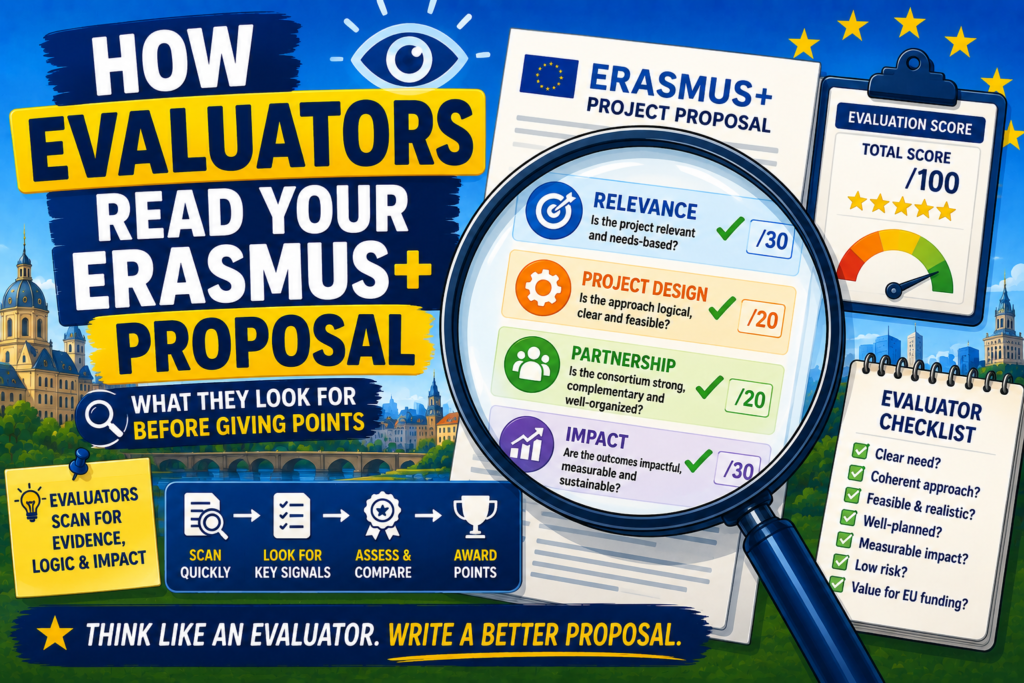
The Relevance section is the most important part of your KA220 application. It is worth 25 points out of 100 — and it determines whether everything else you write gets read seriously. Evaluators who score a proposal low on Relevance rarely find enough in the other criteria to compensate. A strong Relevance score sets the tone for the entire evaluation.
Yet it is also the section that most applicants write last, rush through or treat as an introductory formality. This guide explains exactly what evaluators are looking for in the KA220 Relevance criterion, how each sub-criterion is assessed, and how to write each component in a way that scores in the upper range.
📋 Key Takeaways
- The KA220 Relevance criterion is worth 25 points — minimum pass score is 13 points (you must score above half)
- In ex-aequo situations, Relevance is the first tiebreaker — it determines which proposal gets funded when scores are equal
- The needs analysis is the foundation: without a documented, specific problem statement, the entire Relevance section collapses
- Priority alignment must be integrated throughout the project design — not listed in a separate priorities paragraph
- EU added value must be genuine: evaluators are trained to identify activities that could be delivered nationally without European cooperation
- The most common reason for low Relevance scores is a generic problem description with no evidence
What the 2026 Programme Guide says about KA220 Relevance
The official award criteria for the KA220 Cooperation Partnerships Relevance section are defined in the 2026 Programme Guide as follows. The evaluator assesses the extent to which:
- The proposal is relevant for the objectives and priorities of the Action — and is considered highly relevant if it addresses the “inclusion and diversity” priority, or one or more European Priorities in the national context as announced by the National Agency
- The proposal is relevant for the respect and promotion of shared EU values
- The profile, experience and activities of the participating organisations are relevant for the field of the application
- The proposal is based on a genuine and adequate needs analysis
- The proposal is suitable for creating synergies between different fields of education, training, youth and sport — or has a strong impact on one or more of those fields
- The proposal is innovative
- The proposal is complementary to other initiatives already carried out by the participating organisations
- The proposal brings added value at EU level through results that would not be attained by activities carried out in a single country
Scoring and threshold
Maximum: 25 points. Minimum pass score: 13 points (you must score more than half). If your proposal falls below 13 on Relevance it is automatically rejected regardless of how well it scores on other criteria. In ex-aequo cases — where two proposals have the same total score — Relevance is the first tiebreaker.
Sub-criterion 1: Relevance to programme objectives and priorities
This is the opening sub-criterion and the most broadly scored. Evaluators are asking: does this project belong in KA220? Is the theme — what the project does and who it serves — genuinely aligned with what Erasmus+ Cooperation Partnerships are designed to achieve?
The Programme Guide describes KA220’s primary goal as developing, transferring and implementing innovative practices that increase the quality and relevance of education and training. Your project must demonstrably serve this goal — not just mention it.
What evaluators actually check:
- Does the project address a real challenge in education, training, youth or sport that requires a European cooperation approach?
- Are the outputs of the project (tools, methodologies, resources, frameworks) designed to improve quality or address a gap in the field?
- Is the project’s theme clearly connected to the 2026 priorities — inclusion and diversity, digital transformation, green transition, democratic participation?
The “highly relevant” bonus: The Programme Guide explicitly states a proposal will be considered highly relevant if it addresses the inclusion and diversity priority. This is not just a suggestion — it is an instruction to evaluators to score such proposals higher. If inclusion is genuinely central to your project, make that unmistakably clear in the opening lines of your Relevance section, not buried in a later paragraph.
What to write: Start your Relevance section by naming the specific challenge your project addresses — not a general theme but a specific, documented problem in your field that your target group faces right now. Then connect that problem directly to the KA220 priorities and programme objectives. One paragraph. Specific. Evidence-based.
Sub-criterion 2: EU values
This sub-criterion is worth fewer points than the needs analysis or the priorities, but it is consistently underestimated by applicants. Evaluators are looking for evidence that your project is designed around EU values — not just compliant with them.
The Programme Guide lists the relevant EU values as: respect for human dignity, freedom, democracy, equality, rule of law and respect for human rights, as well as fighting any sort of discrimination.
What most applicants write: “Our project promotes EU values and contributes to a more democratic and inclusive Europe.” This scores close to zero on this sub-criterion.
What evaluators want to see: A concrete connection between your project’s specific activities and a specific EU value. For example:
- A project developing tools for recognising Roma learners’ non-formal learning outcomes — connects to equality and non-discrimination
- A project building media literacy curricula for adult educators — connects to democracy and fighting disinformation
- A project creating accessible digital learning for people with disabilities — connects to human dignity and equality
The connection must be genuine and specific. If your project’s activities do not authentically connect to EU values, you cannot manufacture this connection by adding a generic paragraph — evaluators will see through it.
Sub-criterion 3: Relevance of the participating organisations
This sub-criterion assesses whether the organisations in your consortium are actually the right ones to deliver this project. It is asking: do their profiles, track records and day-to-day activities genuinely qualify them to address the problem you have identified?
This is where the partnership rationale section connects directly to Relevance scoring — even though the partnership is primarily evaluated under the Quality of Partnership criterion (20 points). If your partners are not demonstrably relevant to the project theme, your Relevance score will suffer.
What evaluators check per organisation:
- Does this organisation work directly with the target group the project is addressing?
- Does this organisation have documented experience in the field the project operates in?
- Does the combination of partner profiles cover the necessary expertise to deliver the project’s intended outputs?
Common mistake: Applicants describe their own organisation in detail and give one-line descriptions of partners — “Partner X is an NGO in Italy.” Evaluators need to understand why each partner is in this consortium specifically. Not their general activities, but their specific relevance to this specific project.
What to write: For each partner, explain what specific expertise, target group access or methodological knowledge they bring that is directly relevant to this project’s objectives. Two sentences per partner, specific, not generic.
Sub-criterion 4: Needs analysis (the most important component)
The needs analysis is the foundation of the entire Relevance section. Everything else you claim about your project’s relevance rests on whether you can demonstrate that a genuine, documented need exists for what you are proposing to do.
This is also the component that most applicants get wrong — and where the largest scoring gaps between strong and weak applications occur.
What a weak needs analysis looks like
Most KA220 needs analyses share the same structure and the same problems:
- A broad statement about a general European challenge (“digital skills are increasingly important for the modern workforce”)
- One or two statistics from a generic EU-level report (PISA data, European Skills Agenda, Eurostat)
- A claim that the problem exists in the partner countries (“this challenge is particularly acute in Greece, Italy and Serbia”)
- A conclusion that the project will address this gap
This structure scores 8–10 points on Relevance at best. It is not wrong — it is just not specific enough to convince an evaluator that this project is needed now, by these organisations, for this target group.
What a strong needs analysis looks like
A strong KA220 needs analysis has four components:
1. A specific problem statement — not a broad thematic area but a precise, documented gap. Not “low digital skills among adult educators” but “adult educators in non-formal learning settings lack access to competence frameworks and training that specifically address the use of AI tools in non-formal education — a gap not covered by existing national CPD offers in any of the three partner countries.”
2. Evidence from multiple sources — at least 2–3 sources that document the problem, ideally including one national-level source from each partner country (not all from the same EU report). Sources should be recent (2022–2025), credible and specifically cited. If you have conducted your own survey or focus groups with the target group, this is significantly stronger than secondary sources alone.
3. Target group specificity — the problem must be framed around a defined target group with a documented profile. Not “educators” but “adult education practitioners in non-formal settings working with socially disadvantaged adults aged 25–50 in urban and peri-urban areas across Greece, Italy and Serbia.” The more specific the target group, the more convincing the need.
4. Gap analysis — why existing solutions do not address this need. This is the element most needs analyses skip — they describe the problem without explaining why existing initiatives, tools or frameworks have not solved it. If you cannot explain why this project is needed in addition to what already exists, evaluators will ask that question themselves.
Needs analysis checklist — before you submit
- Problem statement is specific — describes a concrete gap, not a general theme
- Minimum 3 external sources cited, at least one per partner country
- Sources are from 2022 or later
- Target group is defined with specific profile, age range, context and geography
- Gap analysis explains why existing solutions do not address this need
- Erasmus+ Results Platform searched — no directly duplicating funded projects
- The needs analysis is written from the perspective of the target group, not the applicant organisation
Sub-criterion 5: Synergies between fields
This sub-criterion rewards projects that bridge multiple sectors — school education and adult learning, VET and youth, non-formal education and formal qualifications. If your project operates in more than one Erasmus+ field — or if its outputs could be used across fields — make this explicit.
Many applicants tick one field box in the application form and write purely within that field’s framework. If your project genuinely creates synergies — a VET curriculum framework that could also be used by adult education providers, or a youth non-formal education methodology that could be adapted for school settings — say so. Evaluators award credit for cross-field thinking.
If your project is genuinely single-field, focus on demonstrating strong impact within that field rather than claiming cross-field relevance you cannot substantiate.
Sub-criterion 6: Innovation
The innovation sub-criterion is widely misunderstood. Evaluators are not looking for technological novelty or scientific research-level originality. The Programme Guide defines innovation as “considering state-of-the-art methods and techniques, and leading to innovative results and solutions for its field — either in general or for the geographical context in which the project is implemented.”
This means innovation can be:
- Methodological — applying an approach well-established in one field to a new field or context
- Geographic — implementing in countries or communities where this approach has not been tried
- Contextual — adapting an existing methodology to a specific target group that has previously been excluded from it
- Combinatorial — combining two existing approaches in a new way that produces results neither could achieve alone
What to avoid: Claiming innovation without evidence. If you write “our project uses an innovative approach” without explaining what makes it innovative relative to what already exists, evaluators will score this poorly. Innovation claims must be substantiated — compare your approach to the state of the art and explain what is new.
Practical tip: Search the Erasmus+ Results Platform before writing your innovation claim. If a project very similar to yours was funded in the previous call, you need to explain what your project adds that the existing one did not deliver — or you risk evaluators identifying the duplication themselves.
Sub-criterion 7: Complementarity with existing initiatives
This sub-criterion asks whether your project builds on — rather than duplicates — what your partner organisations already do. It is a check on credibility: does this project make sense for these organisations to be doing, given their existing work?
Strong applications show a clear line from existing organisational activities to the project’s objectives. The project emerges logically from what the partners already do — it deepens, extends or transnationalises something they have been building nationally.
What to include:
- Briefly describe the most relevant existing activities or projects of each partner organisation — the ones that directly prepared the ground for this KA220 project
- Explain how this project extends, scales or internationalises those existing activities
- If you have received previous Erasmus+ funding, reference it — it demonstrates capacity and continuity
Common mistake: Describing complementarity as “our project complements existing EU initiatives such as the European Skills Agenda.” Generic references to EU policy documents score nothing. Complementarity must be at the level of the participating organisations’ specific work, not the EU policy landscape.
Sub-criterion 8: EU added value
This is the sub-criterion that trips up the most experienced KA220 applicants. EU added value is a specific concept with a specific meaning: the project produces results that could not be attained through activities in a single country alone.
It is not asking whether your project is international — it is asking whether it needs to be international to achieve its objectives.
The test: Could your project deliver the same outputs and outcomes if all partners were from the same country? If yes — your EU added value argument is weak. If no — explain specifically why not.
Strong EU added value arguments:
- “The problem exists across all three partner countries but manifests differently in each context — only a comparative transnational approach can identify the underlying commonalities and develop transferable solutions”
- “Partner A brings expertise in X that does not exist in Partner B’s country; Partner B brings access to target group Y that Partner A cannot reach nationally; Partner C brings a policy framework Z that provides the regulatory context for scaling the outputs”
- “The outputs — a validated methodology, a training curriculum and a quality framework — will be designed for transferability and tested in three different national contexts, producing evidence of replicability that a single-country project cannot provide”
Weak EU added value arguments:
- “European cooperation enriches our work” — too generic
- “The project addresses European-level challenges” — this describes the problem, not the value of cooperation
- “Partners from three countries will bring diverse perspectives” — diversity alone does not constitute added value
Need Help Writing Your KA220 Relevance Section?
GrowthProjects.eu specialises in KA220 proposal writing — including the Relevance section, needs analysis and priority alignment. Whether you need a section review or a full proposal written from scratch, we bring evaluator-level expertise to every word.
Free initial consultation · March 2026 deadline positions still available
How to integrate the 2026 priorities without a separate priorities paragraph
One of the most common structural mistakes in KA220 Relevance sections is having a dedicated “Priorities” paragraph — a list of the four horizontal priorities with a sentence each explaining how the project addresses them. This format is immediately recognisable to evaluators as a mechanical compliance exercise, not genuine integration.
The 2026 priorities — inclusion and diversity, digital transformation, green transition, democratic participation — should run through your entire Relevance section as connecting threads, not appear as a standalone checklist.
Instead of:
“This project addresses the inclusion priority by including participants with fewer opportunities. It addresses the digital priority by using digital tools. It addresses the green priority by…”
Write:
A needs analysis that identifies a problem faced specifically by people with fewer opportunities — where inclusion is not a claim but the foundation of the problem statement. A description of innovative methodology that is specifically digital — where the digital dimension is not an add-on but central to why the approach works. A dissemination plan that genuinely reaches relevant stakeholders across sectors — where democratic participation is visible in the project’s design, not listed as a priority.
Evaluators read dozens of applications in every round. They can distinguish between priorities that have been designed into a project and priorities that have been applied retrospectively to a project that was conceived without them.
The national priorities dimension
The 2026 Programme Guide includes a specific provision that is easy to miss: a proposal is considered highly relevant if it addresses one or more “European Priorities in the national context” as announced by the National Agency.
Every National Agency publishes a list of national priorities for each call — specific thematic areas or target groups they want to see addressed in KA220 applications from their country. These are not the same as the four horizontal priorities. They are country-specific focus areas — for example, a National Agency might prioritise projects addressing early school leaving, or VET quality, or rural community development, or a specific vulnerable group.
Finding and addressing your National Agency’s published priorities for the 2026 call can meaningfully increase your Relevance score — because the Programme Guide explicitly states this makes a proposal highly relevant. Check your NA’s website for the 2026 national priorities before finalising your Relevance section.
Common scoring mistakes by section
| Sub-criterion | Most Common Mistake | What Evaluators Want Instead |
|---|---|---|
| Programme objectives | Paraphrasing the Programme Guide back to evaluators | Specific connection between your project and the programme goal |
| EU values | Generic “promotes EU values” statement | Named value + concrete connection to specific project activities |
| Partner relevance | One-line descriptions of partner organisations | Why each partner is the right one for this specific project |
| Needs analysis | Broad problem + one EU-level statistic | Specific problem + evidence per country + gap analysis |
| Innovation | “Our project uses an innovative approach” | What specifically is new compared to what already exists |
| Complementarity | References to EU policy documents | Specific existing activities of partner organisations this builds on |
| EU added value | “European cooperation enriches our work” | Why this specific result cannot be achieved in one country alone |
Structuring your Relevance section: a practical template
The KA220 application form does not break the Relevance criterion into separate fields for each sub-criterion. You typically write one continuous narrative response. Here is a structure that covers all eight sub-criteria without feeling mechanical:
Paragraph 1 — The problem (needs analysis + programme relevance)
Open with your specific problem statement. Name the challenge, the target group and the documented evidence. Connect the problem to the KA220 programme objective in the same paragraph — show why this is a cooperation-level challenge, not a national one. 150–200 words.
Paragraph 2 — Why now, why these organisations (partner relevance + complementarity)
Explain why this project is timely — what has changed in the field that makes now the right moment. Then introduce the partnership by explaining what specific expertise or target group access each partner brings. Show how this project builds on what partners already do. 100–150 words.
Paragraph 3 — What is new (innovation + EU values)
Describe what is innovative about your approach compared to existing solutions. Connect the innovation to a specific EU value that the project embodies through its design — not as a general claim but as a consequence of how the project works. 100–150 words.
Paragraph 4 — Why Europe (EU added value + national priorities)
Make your EU added value argument explicitly — why these results require three countries, not one. Reference your National Agency’s published priorities for the 2026 call if applicable. End with the cross-field dimension if relevant. 100–150 words.
Frequently asked questions
How many words should the Relevance section be?
The application form sets a character or word limit per field. In the current online application system, the relevance fields typically allow 4,000–8,000 characters combined. Use the space fully — brevity is not rewarded in Relevance. Every sub-criterion left underdeveloped is a lost point.
Should I address all four horizontal priorities in the Relevance section?
You do not need to address all four. A project that genuinely and specifically addresses one or two priorities scores higher than a project that mentions all four superficially. Choose the priorities that are authentically central to your project and build your Relevance narrative around them.
Can I use data from my own organisation’s experience as evidence for the needs analysis?
Yes — and it is often stronger than secondary sources. A survey you conducted with your target group, documented case studies from your existing work or findings from a previous project’s evaluation report are primary evidence of need. Combine with at least two external secondary sources for a complete evidential base.
Is it better to write the Relevance section first or last?
Write it first in your planning process — it should drive all subsequent sections. But write it last in your final draft — once you know exactly what the project does, who it involves and what it will produce, you can write the Relevance section with the full picture in mind and ensure every claim is substantiated by the project design that follows.
What is the biggest single improvement I can make to a weak Relevance section?
Strengthen the needs analysis. In our experience reviewing KA220 applications, the needs analysis is where the largest point gaps occur. A specific, multi-source, target-group-centred needs analysis with a gap analysis consistently outscores a broad thematic description even when the rest of the application is similar in quality. If you only have time to revise one component, revise the needs analysis.
Need a KA220 Relevance section review or full proposal development?
GrowthProjects.eu provides evaluator-level review and development of KA220 proposals — including section-by-section writing, needs analysis development and full applications for the March 2026 deadline. Contact us for a free initial consultation.
All evaluation criteria and scoring thresholds cited in this article are extracted directly from the official Erasmus+ Programme Guide 2026 (Version 1, published 12 November 2025), pages 239–241. The 25-point maximum and 13-point minimum pass score for the Relevance criterion are confirmed from the Programme Guide award criteria table for KA220 Cooperation Partnerships.