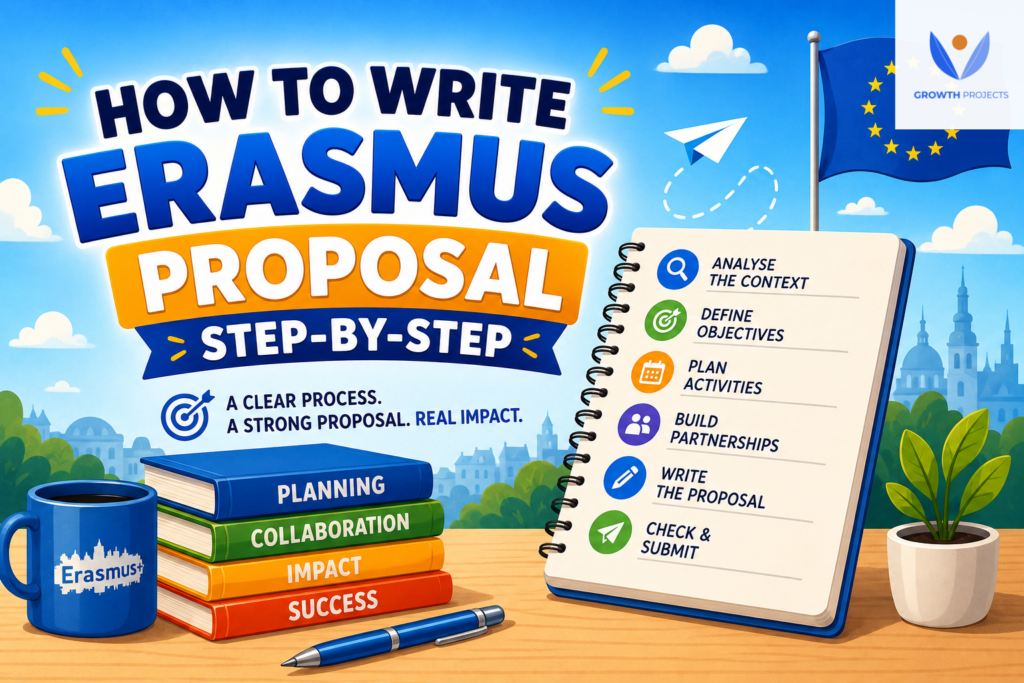
KA210 Small-Scale Partnerships are designed for first-time applicants and smaller organisations — but that does not mean the application is easy to write well. A weak KA210 project description is rejected just as decisively as a weak KA220 application. The lower grant amount does not lower the evaluation bar.
This guide walks through every component of a KA210 project description — what evaluators are looking for in each section, how the scoring works, how to choose the right lump sum tier, and what separates funded applications from the majority that fall below the minimum threshold.
📋 Key Takeaways
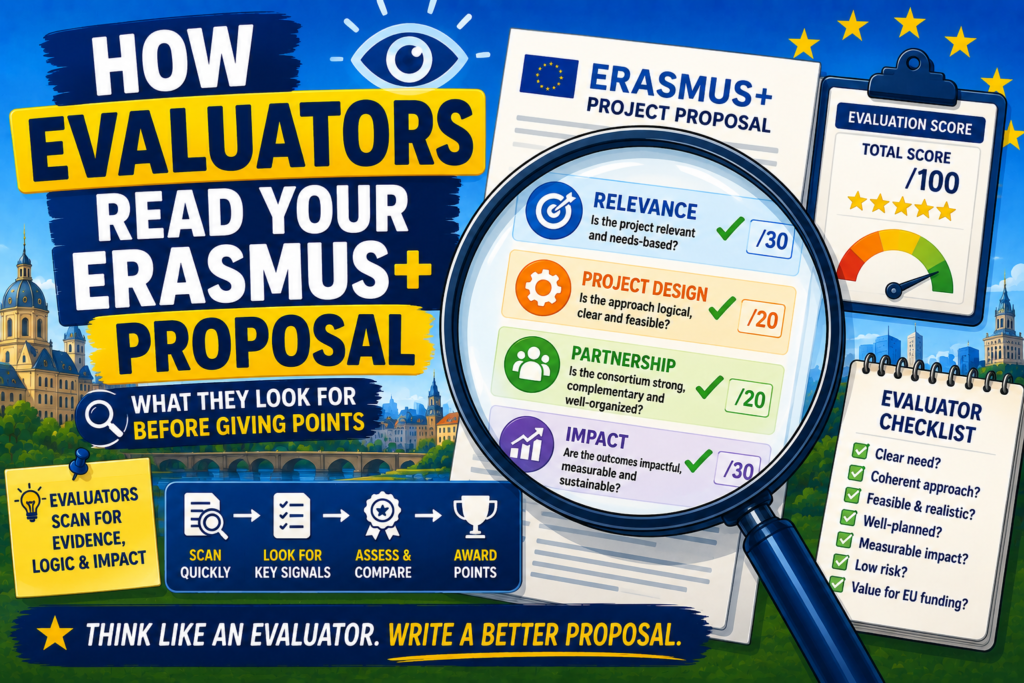
- KA210 has four evaluation criteria: Relevance (30 pts), Quality of Project Design (30 pts), Quality of Partnership (20 pts) and Impact (20 pts) — total 100 points, minimum 60 to pass
- Each criterion has its own minimum threshold — falling below half on any single criterion means automatic rejection
- Lump sum tier selection (€30,000 or €60,000) must be proportionate to your described activities — a mismatch is one of the most common rejection reasons
- KA210 Relevance scores on 30 points — 5 more than KA220 — making it the most heavily weighted criterion
- The needs analysis is the most important component — it is where the largest score differences occur between funded and rejected applications
- Inclusion of people with fewer opportunities makes a proposal explicitly “highly relevant” in the Programme Guide — the strongest single signal to evaluators
How KA210 is scored: the four evaluation criteria
The 2026 Programme Guide defines four award criteria for KA210 Small-Scale Partnerships. Understanding the weight and minimum threshold for each is the starting point for any KA210 project description.
| Criterion | Maximum | Minimum to Pass | Key question evaluators ask |
|---|---|---|---|
| Relevance | 30 pts | 15 pts | Does this project belong in KA210 and address a real need? |
| Quality of Project Design | 30 pts | 15 pts | Is the project well-designed, realistic and proportionate? |
| Quality of Partnership | 20 pts | 10 pts | Are the right organisations working together effectively? |
| Impact | 20 pts | 10 pts | Will this project make a lasting difference? |
Minimum total to pass: 60 points. Fall below the minimum on any single criterion and your application is rejected regardless of the total. In ex-aequo cases, Relevance is the tiebreaker.
KA210 vs KA220: a key scoring difference
KA210 Relevance is worth 30 points — 5 more than KA220 (25 points). This reflects the programme’s explicit focus on widening access and grassroots relevance in KA210. The higher Relevance weight means a strong needs analysis and clear priority alignment matter even more in KA210 than in a KA220 application.
Before you write: the lump sum decision
The lump sum selection — €30,000 or €60,000 — must be made before writing the project description, because it determines the scope and ambition of everything that follows. Many applications fail not because of poor writing but because the lump sum tier selected does not match the activities described.
When to choose €30,000
The €30,000 tier is right for:
- First-time applicants with no prior EU project experience
- Projects with a focused scope — one or two outputs, two or three transnational activities
- Projects with a duration of 6–18 months
- Smaller organisations with limited staff capacity to manage a more complex project
- Projects testing a new approach on a small scale before scaling up
When to choose €60,000
The €60,000 tier is right for:
- Organisations with prior EU project experience who can credibly manage a larger project
- Projects with a broader scope — multiple outputs, more transnational meetings, larger target group
- Projects with a duration of 18–24 months
- Projects where a larger staff investment is clearly justified by the described activities
The proportionality rule: Evaluators are specifically trained to assess whether the lump sum tier is proportionate to the described activities. A €60,000 application with a thin activity plan — two meetings and one PDF document — will score low on Quality of Project Design regardless of how well written the narrative is. A €30,000 application with a clearly scoped, realistic set of activities will score better than an inflated €60,000 application every time.
Criterion 1: Relevance (30 points)
The Programme Guide defines the KA210 Relevance criterion around four specific sub-criteria. The evaluator assesses the extent to which:
- The project is relevant to the objectives and priorities of the Action — and is highly relevant if it addresses inclusion and diversity or the National Agency’s European priorities in the national context
- The project is relevant for the respect and promotion of shared EU values
- The profile, experience and activities of the participating organisations are relevant for the field
- The project brings added value at EU level by building capacity of organisations to engage in cross-border cooperation
Note that KA210 Relevance has a slightly simplified sub-criterion structure compared to KA220 — the Programme Guide removes the innovation, synergies and complementarity sub-criteria, replacing them with a single EU added value sub-criterion focused specifically on cross-border capacity building. This reflects KA210’s purpose: widening access to European cooperation for organisations that have not yet built that capacity.
Writing the Relevance section for KA210
The needs analysis is the foundation. Even though it is not explicitly called out as a separate sub-criterion in the same way as KA220, the Relevance section is built on a documented problem that your project addresses. The evaluator cannot assess relevance without understanding what problem you are solving and for whom.
Write a specific, evidence-based problem statement: what challenge does your target group face, in what context, and why does addressing it require a transnational approach? Keep it concrete and local — the best KA210 needs analyses describe a real situation at organisational or community level, not a generic European challenge.
The inclusion bonus: The Programme Guide states explicitly that a proposal addressing inclusion and diversity will be considered highly relevant. If your project genuinely serves people with fewer opportunities — and you can describe specifically who they are and how the project reaches them — this is the single most powerful signal you can give evaluators in the Relevance section. Do not bury this in a later paragraph. Lead with it.
EU added value for KA210: Unlike KA220, the EU added value in KA210 is not about systemic innovation — it is about organisational capacity building through cross-border cooperation. Your EU added value argument should show how working with a European partner gives your organisation something it cannot achieve alone nationally: exposure to different practices, a comparative perspective, a validated approach tested in more than one context, or access to a methodology developed in another country.
Criterion 2: Quality of Project Design (30 points, minimum 15)
This criterion examines whether your project is well-designed, coherent and feasible. It is the most detailed criterion in the application and covers six distinct sub-criteria.
The evaluator assesses the extent to which:
- Project objectives are clearly defined, realistic and address the needs of participating organisations and their target groups
- Activities are designed in an accessible and inclusive way and are open to people with fewer opportunities
- The methodology is clear, adequate and feasible — including a clear work plan with preparation, implementation and results-sharing phases; cost-effective allocation of resources; quality control and monitoring measures
- The project incorporates digital tools and learning methods to complement physical activities and improve partner cooperation
- The project is designed in an eco-friendly way and incorporates green practices
- The project encourages participation and civic engagement
Defining clear, realistic objectives
Objectives are the most commonly miswritten element of the Quality of Project Design section. Most applicants write objectives that are themes rather than objectives: “to improve digital skills,” “to promote inclusion,” “to develop innovative practices.” These score poorly.
A well-written KA210 objective follows a simple structure: To [action verb] + [specific output or change] + [for whom] + [by when].
- Weak: “To improve the digital competences of adult educators in our organisations”
- Strong: “To develop and pilot a 12-module online training curriculum for adult educators working with socially disadvantaged learners, validated by at least 20 practitioners across both partner organisations, by month 18 of the project”
Objectives must be realistic — achievable within the project timeline and with the resources available from the selected lump sum tier. Evaluators cross-check objectives against activities and budget to verify consistency.
Writing the work plan
The work plan is the backbone of the Quality of Project Design section. It must show a logical, chronological sequence from needs analysis and planning, through development and implementation, to evaluation and dissemination. A well-structured KA210 work plan has four phases:
Phase 1 — Preparation (months 1–3): Setting up project management tools, confirming partner roles, finalising the project work plan, conducting any baseline research or target group consultation needed before development begins. Small but important — evaluators check whether preparation is properly planned or skipped entirely.
Phase 2 — Development (months 3–15 for a 24-month project): The core intellectual work of the project — developing the outputs, running workshops, creating the tools or resources. Each activity should be described with: what it is, who is involved, where it takes place (online or physical, which partner country), how long it takes and what it produces.
Phase 3 — Testing and validation (months 12–20): Piloting outputs with the target group, collecting feedback, revising based on that feedback. This phase demonstrates that your project produces quality-assured results, not just first drafts. Many KA210 applications skip this phase entirely — and lose points as a result.
Phase 4 — Dissemination and evaluation (months 18–24): Making results available beyond the consortium, evaluating the project’s outcomes against its objectives, producing the final report. Be specific about dissemination channels — not “we will share results widely” but “we will publish the training curriculum on EPALE, present findings at [named sector event] and share results with [named stakeholder groups].”
Transnational meetings: quantity and justification
Transnational project meetings are the primary mobility activity in KA210. Each meeting must be justified by a specific purpose in the project work plan — not just scheduled as regular coordination calls.
For a €30,000 project a typical structure is 2–3 transnational meetings: one kick-off meeting, one mid-project development meeting and one final dissemination meeting. For a €60,000 project, 3–5 meetings across a longer timeline is proportionate.
Each meeting should be described with: purpose, agenda overview, outputs expected, which partner hosts it and approximate budget allocation. Evaluators flag meetings that appear scheduled without a clear purpose in the project logic.
The digital and green dimensions
The Programme Guide explicitly includes digital tools and green practices as sub-criteria in Quality of Project Design. These are not optional — they are evaluated. What evaluators do not want is a generic sentence at the end of the methodology section: “The project will use digital tools for communication and will apply green practices where possible.”
For digital: name the specific tools you will use and explain how they contribute to the project’s objectives — not just internal communication (which is expected) but tools that are directly part of the learning or output development process. If your target field is digital skills, the digital dimension is central. If it is not your core field, describe at minimum how online collaboration reduces travel and improves partner cooperation.
For green: describe at minimum your travel approach (green travel for trips under 500km, justified exceptions for longer distances) and any green practices embedded in the project activities themselves. For a €30,000 project, this does not need to be elaborate — but it must be present and specific.
Criterion 3: Quality of Partnership (20 points, minimum 10)
The Partnership criterion evaluates four dimensions:
- Appropriate mix of organisations — do the partners bring different and complementary profiles?
- Newcomers and less experienced organisations — KA210 specifically values involving organisations new to the programme
- Task allocation — do all partners contribute actively, or is the work concentrated in the coordinator?
- Coordination and communication mechanisms — how will partners work together in practice?
Describing the partnership rationale
The most common mistake in the Partnership section is describing what each organisation does rather than explaining why each organisation is in this specific consortium. Evaluators need to understand the strategic rationale for the partnership — not a list of organisational profiles.
For each partner, answer three questions:
- What specific expertise, target group access or methodological knowledge does this partner bring that is directly relevant to this project?
- What role does this partner play that the coordinator cannot play alone?
- What does this partner gain from the project that is relevant to their organisational development?
Task allocation: the 60/40 principle
A common evaluator red flag is a task allocation where the coordinator does 80–90% of the work and partners have minor supporting roles. KA210 is designed as a genuine partnership — both organisations should be actively contributing to outputs, not just participating in meetings.
A healthy KA210 task split generally keeps the coordinator at no more than 60% of the total workload, with partners contributing meaningfully to specific outputs or activities. Where one partner has a smaller role, justify it — smaller organisations with less capacity can still make a valuable contribution if their specific expertise is explained.
Communication mechanisms
Describe your coordination and communication approach specifically: regular video calls (frequency, purpose), a shared project management tool (name it), a communication protocol for decision-making, and how you will manage the partnership agreement. Generic “we will maintain regular communication” scores nothing. Specific mechanisms — “monthly 90-minute progress calls, a shared Trello board, a written decision log, quarterly financial reconciliation” — demonstrate project management capacity.
Criterion 4: Impact (20 points, minimum 10)
The Impact criterion evaluates whether your project will make a lasting difference — beyond the project timeline and beyond the consortium organisations themselves. Four sub-criteria:
- Integration into regular work — how will participating organisations embed the project results into their ongoing activities after the project ends?
- Positive impact on participants, organisations and wider community — who specifically will benefit and how?
- Evaluation — how will you measure whether the project achieved its objectives?
- Dissemination — how will you make results known beyond the consortium?
Integration into regular work (sustainability)
This is the sub-criterion most often ignored by first-time KA210 applicants. The project ends but its results should continue to be used. For each main output, describe concretely how it will be used after the project: the training curriculum will be integrated into the coordinator’s standard training offer; the methodology guide will be shared with the partner’s regional network; the digital tool will remain freely available on the project website for three years after project completion.
Vague sustainability statements score poorly: “the project will have lasting impact on our organisations.” Specific ones score well: “the validated training framework will be incorporated into Partner B’s annual professional development programme from Year 2, reaching approximately 40 adult educators per year.”
Writing a credible evaluation plan
Many KA210 applications skip the evaluation plan entirely or write a single sentence about it. This is a straightforward scoring loss. The evaluation plan does not need to be complex for a €30,000 project — but it must be present and specific.
A basic KA210 evaluation plan includes:
- 2–3 measurable indicators linked to specific objectives — quantitative (number of outputs produced, number of beneficiaries reached, number of practitioners trained) and qualitative (satisfaction ratings, competence self-assessments before and after)
- A timeline for when each indicator is measured — mid-point check and final evaluation
- Who is responsible for collecting and analysing evaluation data
- How evaluation findings will be used to improve the project during implementation
Dissemination: specific channels, not generic intentions
Dissemination plans are evaluated on specificity. “We will disseminate results through social media and our website” is the baseline expectation, not a differentiated approach. Evaluators look for channels that reach the relevant professional or community audience beyond the applicant organisations:
- EPALE publication (for adult education, school education and VET fields)
- European Youth Portal (for youth field projects)
- Sector-specific professional networks, conferences or publications
- Local authorities, school networks or employer associations who could use or scale the outputs
- Erasmus+ Results Platform publication (required for all funded projects)
Need Help Writing Your KA210 Application?
GrowthProjects.eu specialises in KA210 proposal writing for first-time and experienced applicants — from project concept development and partner matching to full application writing for the March 2026 deadline.
Free initial consultation · March 2026 deadline
Common reasons KA210 applications are rejected
Lump sum tier disproportionate to activities described. The most common reason. A €60,000 application with activities that clearly cost €20,000–€25,000 to deliver will score low on Quality of Project Design. A €30,000 application that promises outputs requiring €50,000+ of staff time to produce will raise immediate feasibility concerns. Always estimate realistic staff costs before selecting your tier.
Needs analysis too generic. “Digital skills are increasingly important for our sector” is not a needs analysis. It describes a trend, not a documented need facing a specific target group in a specific context. Every funded KA210 application can answer: who exactly has this problem, in what context, how do we know, and why does addressing it require European cooperation?
Objectives describe themes not outcomes. Objectives like “to promote inclusion” or “to develop digital skills” are themes. An objective is a specific, measurable change the project will produce. If you cannot describe how you will know whether the objective has been achieved, it is a theme, not an objective.
Partnership rationale based on friendship not complementarity. “We have worked with this partner before and have a good relationship” is a coordination advantage, not a strategic rationale. Every partner must bring something specific and distinct to the project that the coordinator cannot provide alone.
Activities described but outputs not defined. The project description must clearly state what the project will produce — not just what it will do. Activities are the means; outputs are the deliverables. “We will organise workshops” is an activity. “We will develop and pilot a 6-module facilitation guide, tested with 15 practitioners per partner organisation” is an output with a delivery mechanism.
Impact section missing or generic. Many first-time KA210 applicants treat Impact as an afterthought. Any section scoring below the minimum threshold (10 points for Impact) means automatic rejection. A specific sustainability plan and a credible dissemination approach are not optional extras — they are threshold requirements.
Frequently asked questions
How many activities should a KA210 project have?
For a €30,000 project: 2–3 transnational meetings plus 1–2 output development phases. For a €60,000 project: 3–5 transnational meetings plus 2–4 output development phases. The key is not quantity but coherence — every activity must be clearly connected to a specific objective and a specific output. More activities do not mean a higher score; proportionate, well-justified activities do.
Can a KA210 project have more than two partners?
Yes — there is no maximum number of partners in KA210. However, the minimum is two organisations from two different programme countries. Adding more partners increases management complexity for a relatively small grant. For first-time applicants, two partners is almost always the right choice.
Do I need to produce intellectual outputs in KA210?
No — KA210 does not require intellectual outputs (IOs) in the same way KA220 does. Your project can produce reports, training modules, toolkits, curricula, guides, methodologies, digital tools or community resources — whatever is appropriate for your project’s objectives. What matters is that outputs are clearly defined and proportionate to the lump sum selected.
Can KA210 activities be fully online?
Yes — KA210 allows a flexible mix of physical and virtual activities. The Programme Guide explicitly encourages the use of digital tools and virtual cooperation. You can have a fully online project, a hybrid project or a project with transnational physical meetings — whichever best serves your project’s objectives and your partners’ capacities.
Is KA210 a good stepping stone to KA220?
Yes — and this is exactly how the Programme Guide frames it. KA210 is described as “a first step for organisations into cooperation at European level.” A completed KA210 project gives your organisation EU project management experience, a European partner relationship and a funded track record — all of which significantly strengthen a subsequent KA220 application.
Ready to write your KA210 application for March 2026?
GrowthProjects.eu provides full KA210 application development — from project concept and partner matching through to a complete, evaluator-standard application. We also offer section reviews and Quality Assessment resubmissions for organisations that have applied before. Contact us for a free initial consultation.
All evaluation criteria, scoring thresholds and programme rules cited in this article are extracted directly from the official Erasmus+ Programme Guide 2026 (Version 1, published 12 November 2025), pages 244–249. The four award criteria, point allocations and minimum thresholds are confirmed from the Programme Guide award criteria table for Small-Scale Partnerships (KA210).